Heat Exchangers
Metal Fabrication

Aerospace environments penalize excess mass. Onboard weight budgets are rigid. Launch vehicles require extreme thermal control under severe conditions. Traditional shell-and-tube heat exchangers are too heavy and voluminous. Printed Circuit Heat Exchangers (PCHEs) solve these structural problems.
A PCHE consists of chemically etched metal plates. These plates are diffusion-bonded into a solid metal block. The final unit is monolithic. It behaves like a single piece of metal. This construction gives PCHEs massive advantages over older designs. They offer much higher surface area per unit volume. They reduce total component mass significantly. They tolerate extreme internal pressures. These traits are vital when designing space propulsion systems. Every ounce saved increases payload capacity. Every inch of space saved allows for better component layout. System reliability cannot be compromised.
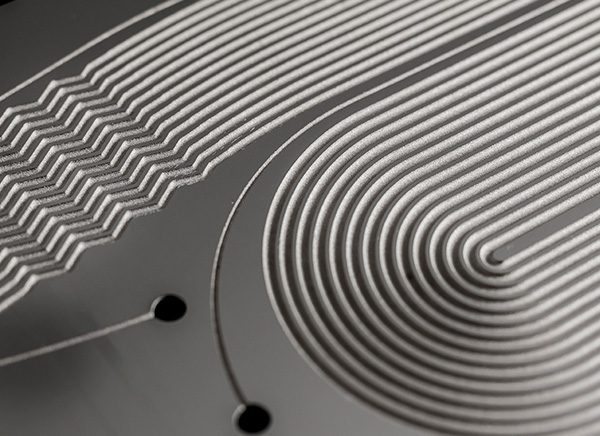
The thermal performance of a PCHE depends entirely on its internal channels. Photochemical machining (PCM) is the manufacturing method used to create these internal paths. The process yields PCM channel plates. These plates feature complex internal geometries. These geometries dictate fluid efficiency.
Engineers can design zigzag, wavy, or airfoil channel profiles. Hybrid designs can create deliberate turbulence to boost heat transfer. PCM etches these precise paths into flat metal sheets, so the process works through chemical removal rather than mechanical force. This distinction matters to product engineers. Mechanical stamping stresses metal. Laser cutting leaves heat-affected zones and burrs. PCM introduces zero mechanical stress. It leaves zero burrs. The material properties of the parent alloy remain unchanged during processing.
Tight dimensional tolerances are critical for fluid dynamics. PCM delivers these tolerances consistently. The process is highly repeatable. This repeatability makes it excellent for scaling from prototyping to full production. During early development, engineers often need to test multiple channel profiles. PCM accommodates fast prototyping. Tooling is digital. Changing a channel design requires editing a CAD file, not machining a new physical die. This speed reduces development cycles for program managers.
Program managers often look at Micro Channel Heat Exchangers (MCHEs) alongside PCHEs. These systems serve different niches. MCHEs often rely on hydroforming rather than stamping or chemical etching. Hydroforming can produce smaller, more precise channels than traditional stamping. However, for the high-pressure demands of launch systems, PCM channel plates in PCHEs remain the baseline choice.
Stamping lacks the precision required for complex microchannels. It can warp thin sheets. Laser cutting is too slow for dense channel matrices. It also creates thermal stress. PCM bypasses these limitations by handling complex channel layouts without physical tool wear. The chemical etchant removes metal uniformly, which allows for complex fluid paths that are impossible to construct with standard machining.
 Propulsion Applications
Modern rocket engines demand precise thermal management at multiple stages.
Rocket systems use liquid hydrogen, liquid oxygen, and liquid methane. These propellants must remain at precise temperatures before engine ignition. Small temperature changes alter liquid density. Changes in density disrupt fuel-to-oxidizer ratios. PCHEs manage this temperature control efficiently. They regulate fluid density and prevent premature boil-off.
Liquid propellant circulates around the combustion chamber and nozzle before injection. This fluid absorbs extreme heat from the combustion process. This cooling protects the engine structure from melting. The pressures inside modern engines are immense. Full-flow staged combustion designs require components that endure extreme stress. PCM channel plates provide the fine geometries needed to extract high heat flux. The diffusion-bonded block handles these high chamber pressures safely. Reusable launch vehicles rely heavily on this thermal endurance.
Hypersonic flight introduces massive aerodynamic heating. Air friction creates extreme skin temperatures. These platforms need lightweight thermal management. Traditional heat exchangers add too much weight. PCHEs fit into compact envelopes. They manage skin cooling by transferring heat into the onboard fuel. The fuel acts as a heat sink before it enters the engine. This system protects structural components without compromising the vehicle’s aerodynamics.
Advanced space propulsion concepts also utilize PCHEs. Closed Brayton cycle systems require compact heat exchangers to maximize efficiency. Nuclear thermal propulsion designs demand high structural integrity under extreme heat. Lunar and Mars surface power systems face strict size and weight limits. PCHEs meet these demands through their compact form factor and high pressure capability.
Program managers track specific metrics when qualifying hardware.
Engineers must balance performance, manufacturability, and timeline. PCM channel plates provide a path to meet all three criteria. The process supports quick design iterations during prototyping. It scales smoothly into production. As propulsion systems move toward higher operational pressures, thermal management demands superior hardware. PCHEs built via PCM deliver the required performance within a compact envelope. They solve thermal problems efficiently.

4020 Jeffrey Blvd. | BUFFALO, NY 14219
P: (716) 821-9393 / (800) 875-1093
Website by Luminus