Heat Exchangers
Metal Fabrication
Heat is the main cause of equipment failure in high-performance manufacturing. Concentrated thermal loads shorten component life, drive process variation, and compromise product quality in ways that are difficult to diagnose and expensive to correct. In temperature-sensitive applications—semiconductor lithography, precision grinding, laser processing, power electronics —even slight temperature swings at the work surface translate directly into defects, yield loss, or premature hardware failure.
The cooling plates provide a solution that starts at the source. They directly contact the heat-generating component, and the cooling medium (usually water, deionized water, or a mixture of glycol and water) flows through the internal channels in order to pull heat from the component.
Early cooling plate designs used hollow cavities or simple drilled passages. These work in low-demand applications. They fall short where thermal uniformity and precise heat extraction are required. Modern high-performance designs use precision-formed internal channels that control fluid flow behavior and maximize heat transfer across the plate surface. The industry moved in this direction for a clear reason: channeled designs perform significantly better than open-cavity alternatives.
The terminology is worth clarifying. “Cooling plate” is the broad category—any plate-format device that extracts heat from a component in contact with it. “Channel plate” refers to a plate with precision-engineered internal geometry. In a printed circuit heat exchanger (PCHE), channel plates handle fluid-to-fluid heat transfer across a bonded stack. A cooling plate, by contrast, handles component-to-fluid heat extraction. One face contacts the heat source; the other contacts the cooling fluid. The engineering focus in either case is the internal geometry, because that is where performance is determined.
The thermal resistance of a cooling plate depends on three factors: material conductivity, wall thickness, and the convective heat transfer coefficient within the channel. Of these, channel geometry has the greatest influence.
Straight channels produce laminar flow, which keeps heat transfer rates low. When geometry introduces disruption—wavy paths, serpentine layouts, pin-fin arrays—the boundary layer breaks down. Fluid mixes. Heat transfer increases substantially. The difference between a straight channel and a well-designed serpentine geometry is not marginal. It determines whether a plate meets performance requirements or falls short of them.
Temperature uniformity across the plate surface follows directly from how accurately those channels are produced. In applications where variation of even a single degree affects yield or dimensional accuracy, channel precision is non-negotiable. Uniformity within 1°C is achievable, but only with channel networks that are designed and manufactured to exacting standards.
 How Photochemical Machining Produces Better Channels
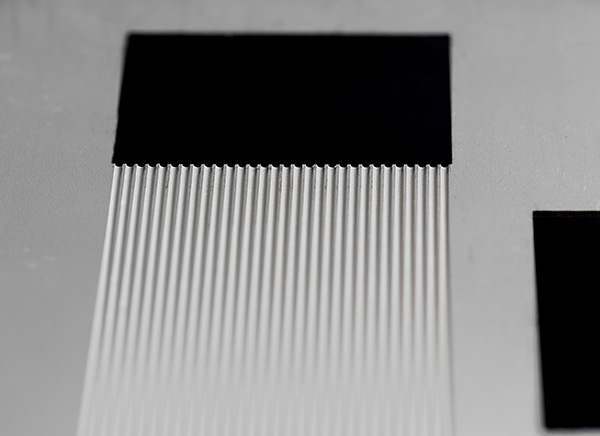
Photochemical machining (PCM) is a subtractive manufacturing process that uses a photoresist mask and chemical etchant to remove material with high precision. No mechanical tooling contacts the part. No heat is introduced. No mechanical stress transfers to the base metal.
For cooling plate production, this matters considerably. Stamping, drilling, and laser cutting all introduce some form of stress or debris. Stamped channels can leave burrs along channel walls. Laser cutting generates heat-affected zones that alter material properties near the cut edge. Drilled passages face geometric limitations; curves, tapers, and fine wall thicknesses are simply not achievable.
PCM removes those constraints. Channel widths from 0.2 mm to 4.0 mm (.008″ to .160″) are produced with tight, repeatable tolerances and clean walls. Wavy, serpentine, and pin-fin geometries carry no additional tooling penalty; geometric complexity costs the same as a straight channel. Thin walls maximize the conduction path without sacrificing structural integrity. Because the process is non-contact, the base material’s fatigue resistance, corrosion resistance, and thermal conductivity remain fully intact.
Burr-free surfaces are a specific requirement wherever deionized water circuits are used. In semiconductor and laser processing equipment, particulate contamination in the cooling circuit is unacceptable. PCM-produced channels generate no debris. Surfaces are clean and ready for downstream assembly processes.
Individual etched plates are combined into sealed, monolithic assemblies through diffusion bonding or vacuum brazing. The result: no gaskets, no mechanical joints, no leak paths. The flat, clean surfaces PCM produces are well-suited for both bonding methods; surface quality directly affects bond strength and long-term sealing integrity.
In stacked or manifolded assemblies, dimensional consistency plate to plate is critical. Flow balance across a stack depends on channels that match exactly at every layer. PCM holds those tolerances consistently across production runs, which means performance validated at the prototype stage carries directly into production hardware.
High-heat environments span many industries. PCM-produced channel plates address thermal management demands across all of them:
PCM handles prototyping efficiently. Because tooling is a photomask, geometry changes are a digital file update, not a new tool order. Engineers can iterate through multiple channel designs at the prototype stage without committing to hard tooling costs. That speed matters early in a development program, when thermal performance is still being validated against real-world load conditions.
That same process then runs production volumes. There is no re-qualification step between prototype and production. The geometry validated at prototype is the geometry produced in volume—same tolerances, same material properties, same surface condition. For program managers balancing schedule risk against performance requirements, continuity is a meaningful advantage.
Ultimately, thermal management comes down to geometry. The channel network inside a cooling plate determines how heat moves, how uniformly it distributes, and how reliably that performance holds over time. PCM makes it possible to produce that geometry accurately across materials, across complexity levels, and from prototype through full production without the trade-offs conventional methods impose.

4020 Jeffrey Blvd. | BUFFALO, NY 14219
P: (716) 821-9393 / (800) 875-1093
Website by Luminus