Chemical Etching
Metal Fabrication

No matter what kind of manufacturing environment is in place, the importance of a reliable supplier network cannot be stressed enough. In an industry where success is measured by precision and consistency, supplier audits are checkpoints that, in addition to risk mitigation, provide opportunities to strengthen collaboration, validate quality, and build confidence. A thoroughly planned audit not only safeguards programs from risk but also deepens the mutual understanding between partners.
The use of supplier audits in precision metal manufacturing through Photochemical Machining (PCM) has become a vital instrument for fostering transparency, continuous improvement, and being in tune with customer needs in the long term. It is true that a lot of engineers and project managers are acquainted with the concept of audits in the context of stamping or machining; however, the PCM method has its own subtleties, which are worth discussing.
A supplier audit is a systematic review of a vendor’s processes, quality management, and compliance with customer requirements. It allows manufacturers to evaluate how parts are produced, documented, and controlled throughout the supply chain.
In most manufacturing settings, audits fall into three categories:
These audits provide structure for open communication, revealing how both sides can contribute to improved quality and reliability. In the context of PCM, where parts are chemically etched instead of cut or stamped, audits help bridge the gap in understanding for customers less familiar with the process.
 How Supplier Audits Add Value for PCM Manufacturers
Conducting audits in the PCM process provides:
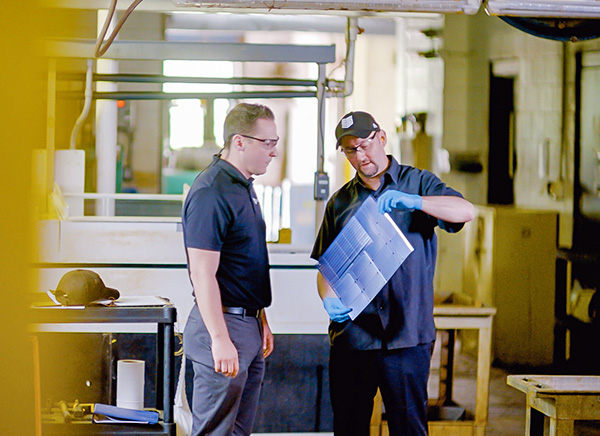
Transparency is at the heart of every supplier relationship, and supplier audits create the setting for genuine visibility. They allow customers to see process control firsthand—from phototooling and chemical handling to inspection and packaging. They are immersive experiences, often lasting an entire day or more, and they give customers the chance to meet the people behind the process.
Understanding the “who” often clarifies the “how” and “why.” They leave with a clear view of how precision and repeatability are built into each step. These visits also highlight why PCM differs from stamping, machining, or laser cutting. The absence of mechanical stress eliminates distortion, while chemical etching allows intricate patterns without altering material properties. Seeing this process in action transforms assumption into assurance.
While audits validate capability, they also serve as valuable learning tools. Every customer who steps into the facility brings a fresh perspective. Their questions, observations, and requests often identify opportunities for refinement that internal teams might overlook.
These insights frequently lead to enhancements in documentation, traceability, and preventive maintenance practices. Each suggestion, once implemented, benefits all future customers.
Incorporating feedback from audits supports broader quality goals and deepens the ISO framework. Over time, a company sees tangible improvements in process consistency and efficiency, largely driven by constructive customer dialogue. Continuous improvement is an ongoing collaboration between the manufacturer and the customer, and supplier audits keep that collaboration active.
Audits also create a unique environment for problem-solving and technical collaboration. They allow customers and suppliers to exchange ideas beyond inspection checklists and compliance reports. These discussions often evolve into design-for-manufacturability sessions where both sides analyze tolerances, feature sizes, and material behavior to achieve the best results.
By understanding PCM’s specific capabilities, customers can make more informed design choices that align with chemical etching’s strengths. This collaboration often leads to faster development cycles, fewer engineering changes, and smoother production transitions. The shared experience of walking through the process fosters alignment, which forms the foundation for long-term partnerships built on communication, mutual respect, and a shared technical understanding.
 A Real Example: Process Improvement Born from Collaboration
One of Switzer’s customers, a manufacturer of etched flow-field plates for hydrogen fuel cells, conducted a full-day audit at Switzer’s facility. Their goal was to gain a deeper insight into the etching, cleaning, inspection, and shipping processes that support their critical components.
During the review, both teams identified an opportunity to improve packaging for these delicate plates. The existing approach protected the parts but created inefficiencies during the customer’s assembly process. Operators had to handle each plate multiple times before it reached the assembly cell, increasing the risk of surface contamination or bending.
Together, Switzer and the customer set two objectives: safeguard the parts during shipping and simplify how operators unpacked and staged them for assembly. Through joint brainstorming and prototyping, the teams developed a custom packaging fixture. The new design used layered, reusable materials that securely nested each plate while maintaining the correct orientation for easy removal. The result was a packaging system that offered better protection and faster workflow integration.
A supplier audit delivers lasting value when it’s organized, objective, and action-oriented. The following best practices help both customer and supplier achieve consistent, high-quality outcomes:
Developing a strong supplier audit process is about connection, learning, and mutual growth. For Switzer, every audit is an opportunity to demonstrate technical excellence, refine internal systems, and strengthen customer relationships.
In industries where precision metal components define performance, trust is built through visibility and collaboration. By welcoming customers into its PCM environment, any company can transform audits into shared problem-solving sessions.
4020 Jeffrey Blvd. | BUFFALO, NY 14219
P: (716) 821-9393 / (800) 875-1093
Website by Luminus